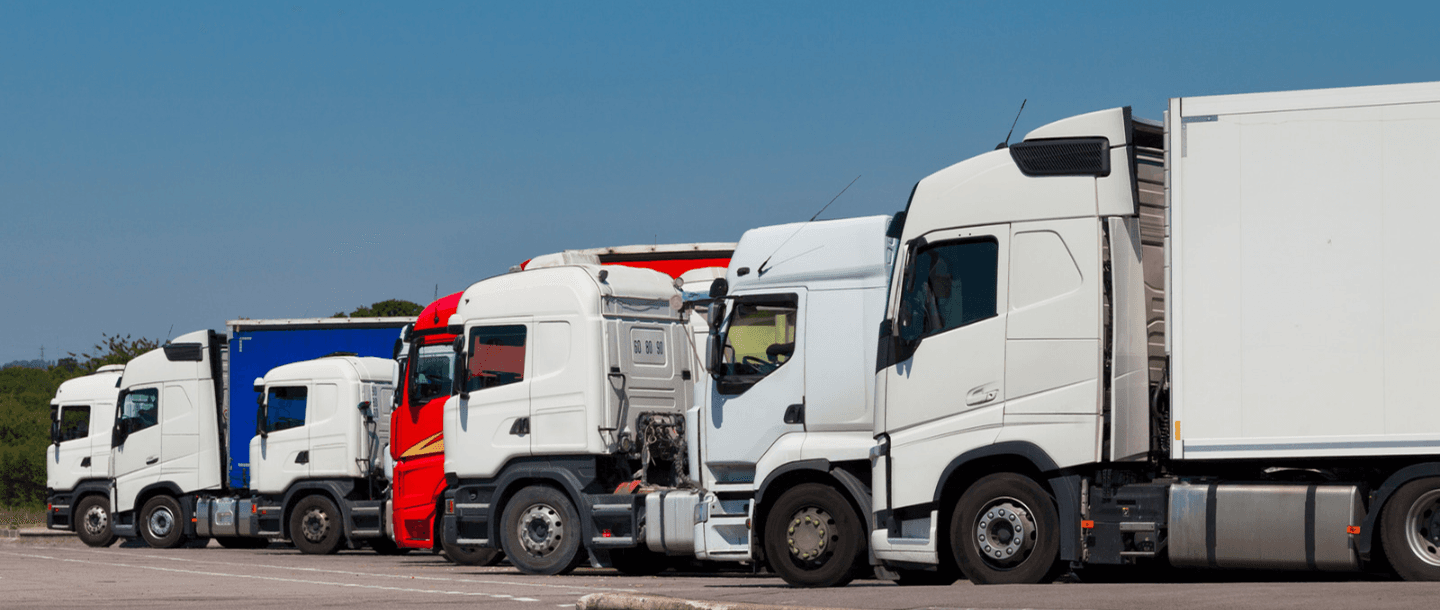
Take any one of these on its own, or hand us the whole lane and hold one team to the delivery date and the landed cost. Most clients start with the leg that hurts and expand from there.
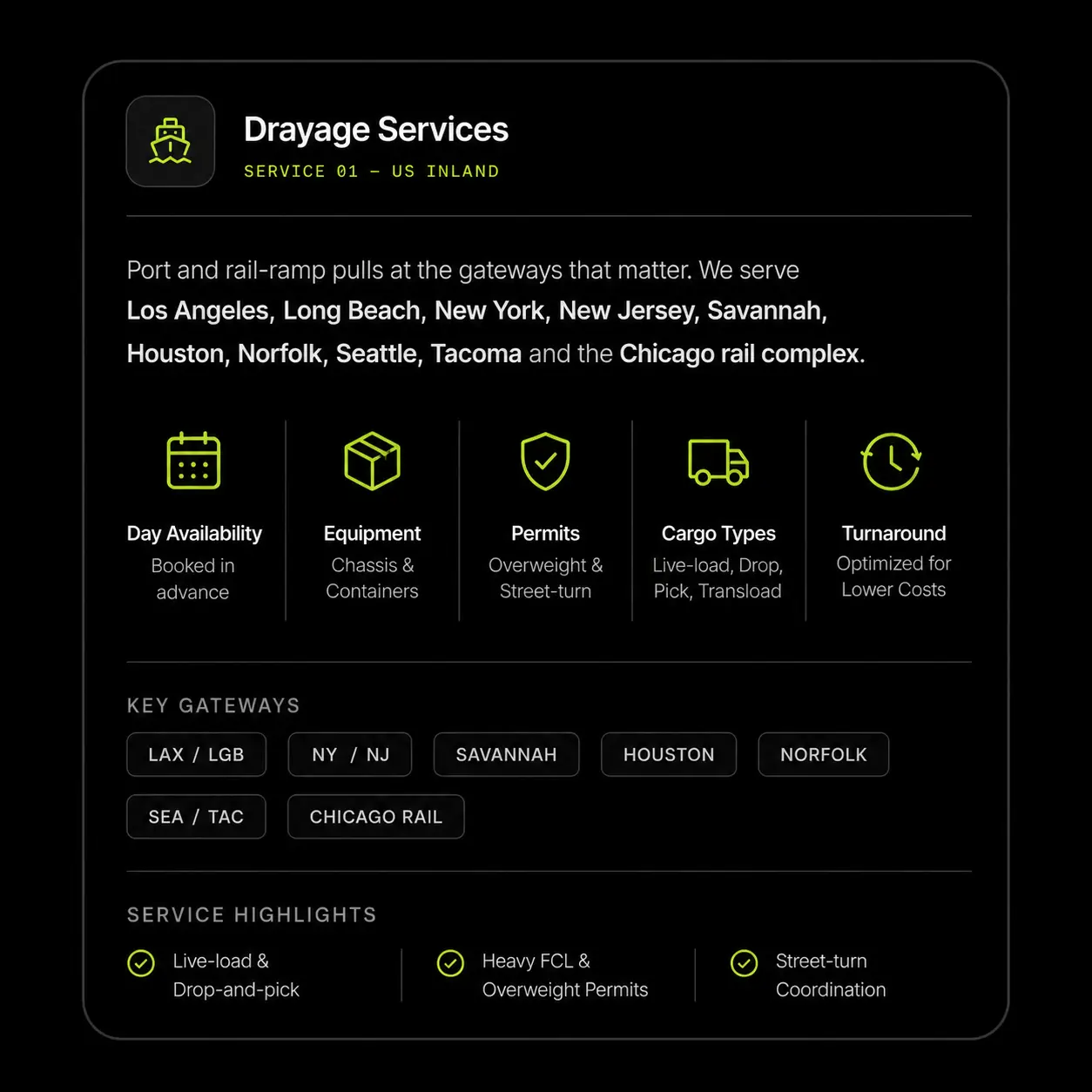
Port and rail-ramp pulls at the gateways that matter for Asia-origin freight — Los Angeles and Long Beach, New York and New Jersey, Savannah, Houston, Norfolk, Seattle–Tacoma and the Chicago rail complex. We run drayage against free time rather than convenience: appointments are booked the day availability posts, chassis are sourced before the container is released, and demurrage and per diem exposure is reported daily so nobody discovers a five-figure accessorial at month end.
Live-load, drop-and-pick, transloads to 53ft domestic equipment, triaxle and overweight permits for heavy FCL, and street-turn coordination to cut empty return cost.
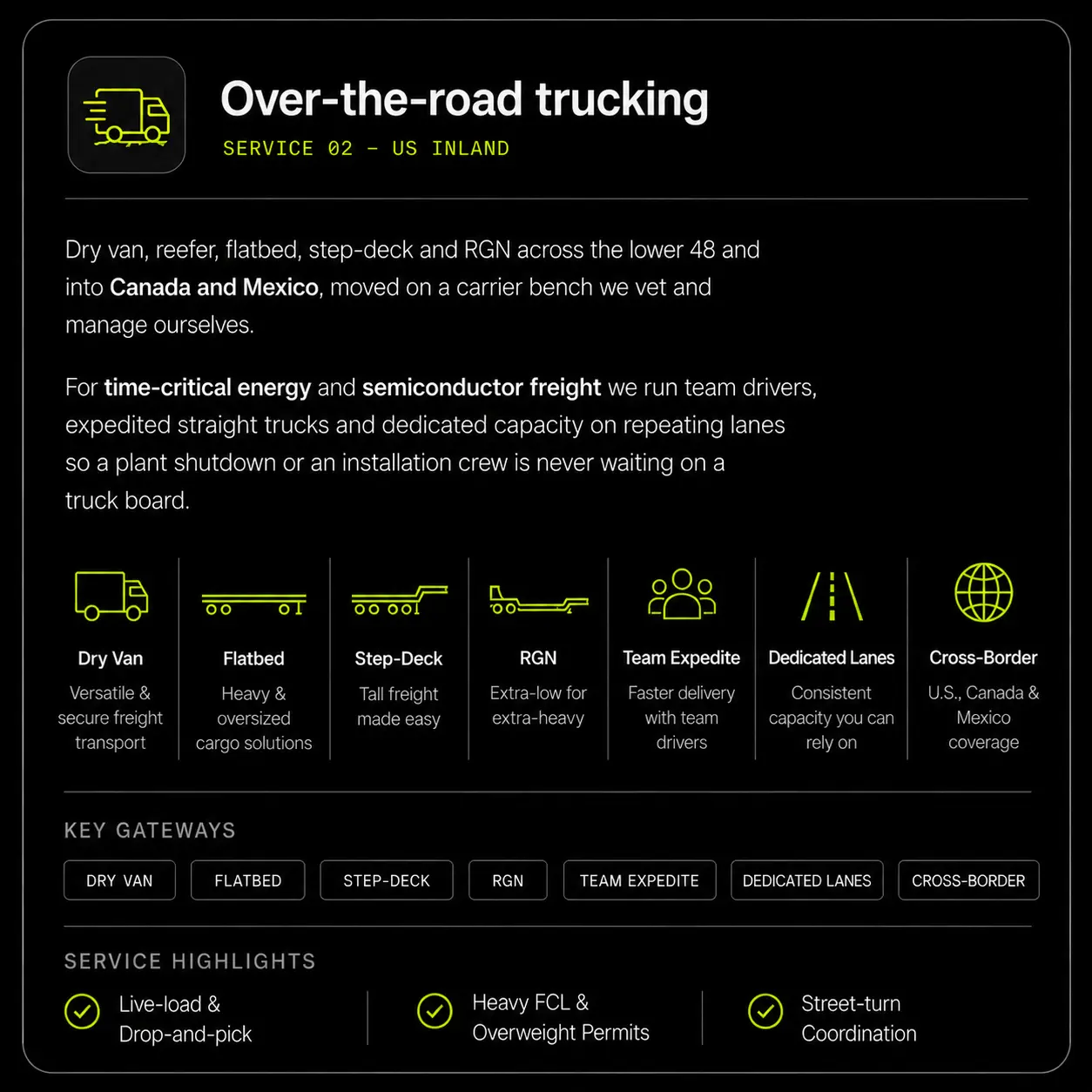
Dry van, reefer, flatbed, step-deck and RGN across the lower 48 and into Canada and Mexico, moved on a carrier bench we vet and manage ourselves. Every carrier is checked on active FMCSA operating authority, insurance certificates naming the correct parties, safety and inspection history, and a signed broker–carrier agreement before a load is tendered — not after a claim lands.
For time-critical energy and semiconductor freight we run team drivers, expedited straight trucks and dedicated capacity on repeating lanes so a plant shutdown or an installation crew is never waiting on a truck board.
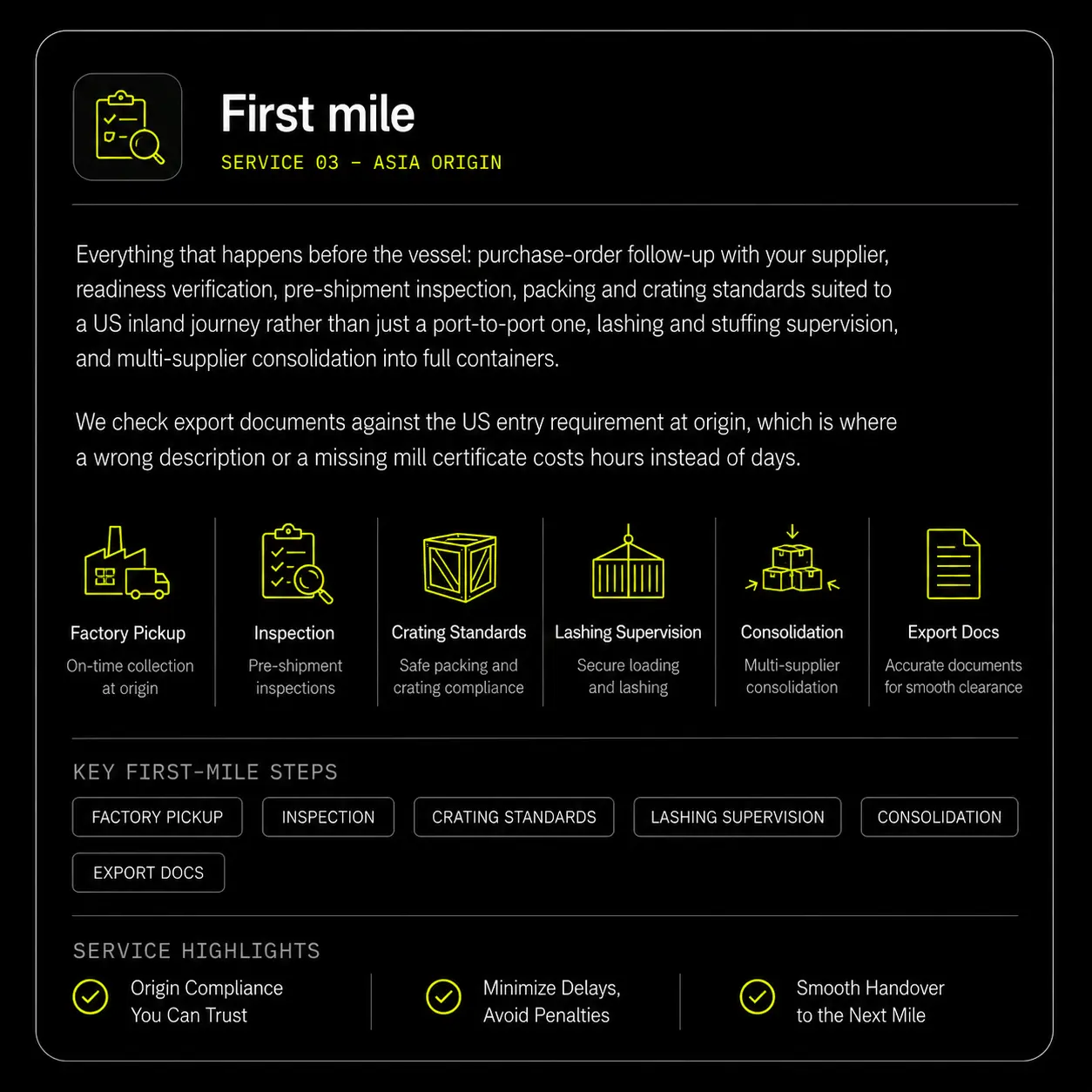
Everything that happens before the vessel: purchase-order follow-up with your supplier, readiness verification, pre-shipment inspection, packing and crating standards suited to a US inland journey rather than just a port-to-port one, lashing and stuffing supervision, and multi-supplier consolidation into full containers.
We check export documents against the US entry requirement at origin, which is where a wrong description or a missing mill certificate costs hours instead of days.
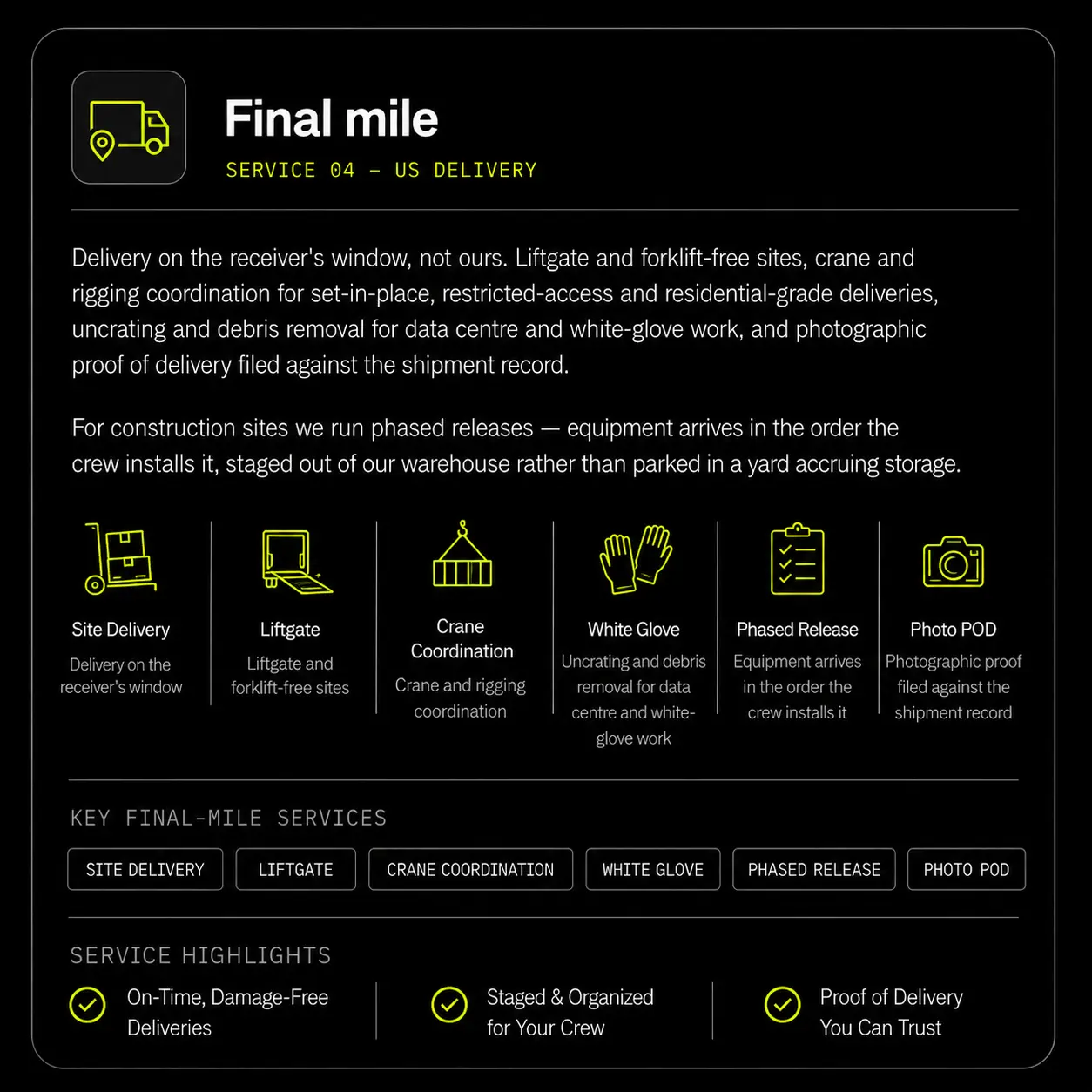
Delivery on the receiver's window, not ours. Liftgate and forklift-free sites, crane and rigging coordination for set-in-place, restricted-access and residential-grade deliveries, uncrating and debris removal for data centre and white-glove work, and photographic proof of delivery filed against the shipment record.
For construction sites we run phased releases — equipment arrives in the order the crew installs it, staged out of our warehouse rather than parked in a yard accruing storage.
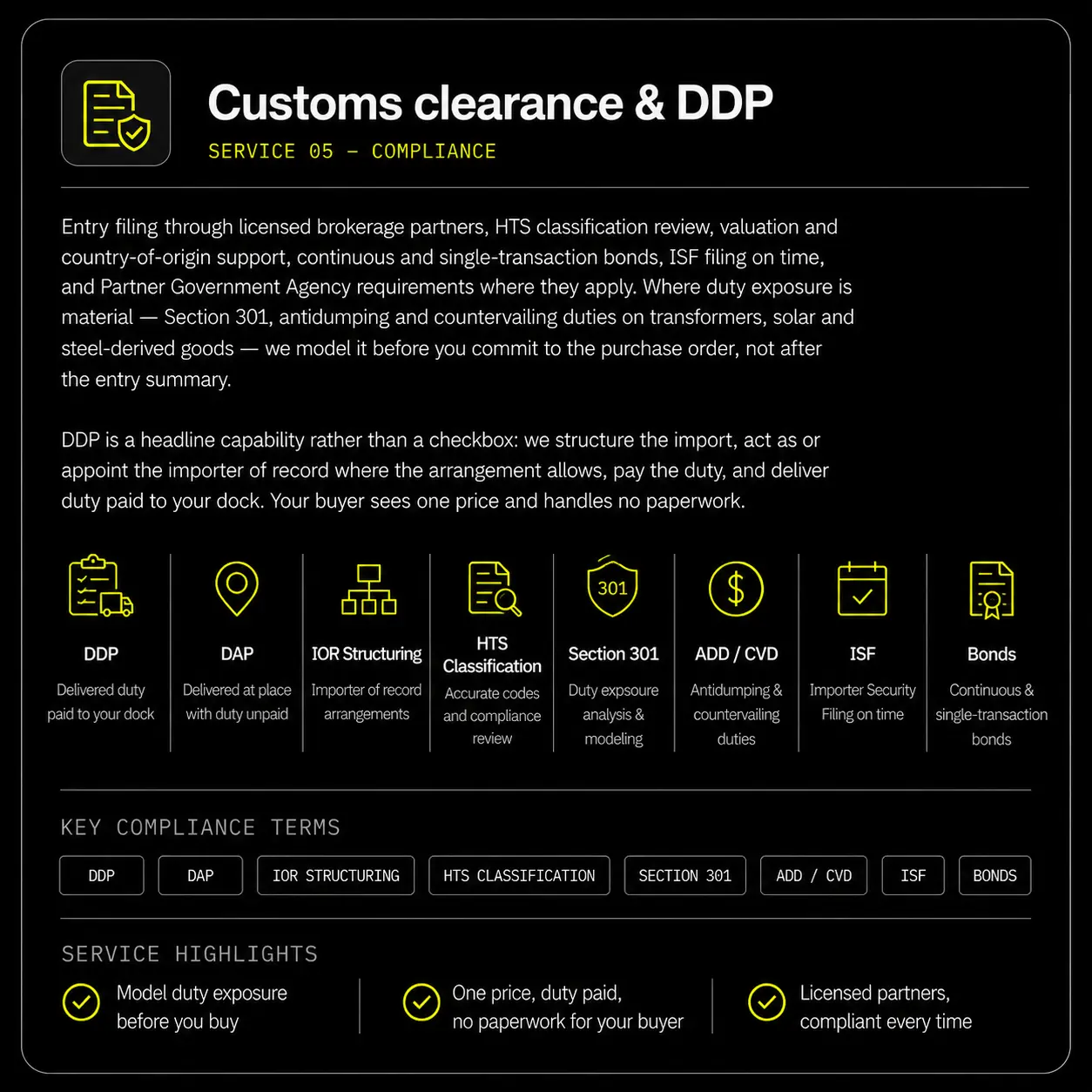
Entry filing through licensed brokerage partners, HTS classification review, valuation and country-of-origin support, continuous and single-transaction bonds, ISF filing on time, and Partner Government Agency requirements where they apply. Where duty exposure is material — Section 301, antidumping and countervailing duties on transformers, solar and steel-derived goods — we model it before you commit to the purchase order, not after the entry summary.
DDP is a headline capability rather than a checkbox: we structure the import, act as or appoint the importer of record where the arrangement allows, pay the duty, and deliver duty paid to your dock. Your buyer sees one price and handles no paperwork.
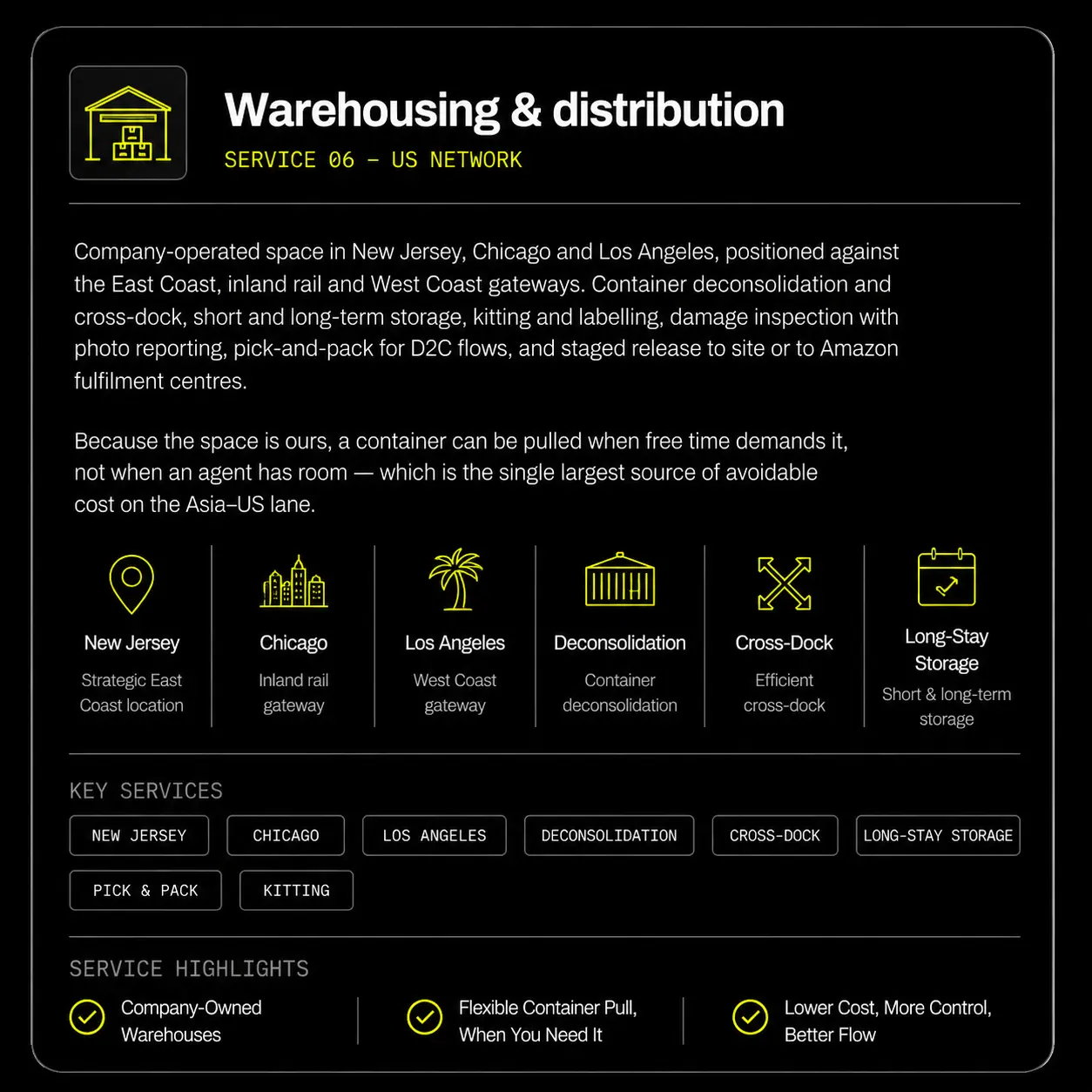
Company-operated space in New Jersey, Chicago and Los Angeles, positioned against the East Coast, inland rail and West Coast gateways. Container deconsolidation and cross-dock, short and long-term storage, kitting and labelling, damage inspection with photo reporting, pick-and-pack for D2C flows, and staged release to site or to Amazon fulfilment centres.
Because the space is ours, a container can be pulled when free time demands it, not when an agent has room — which is the single largest source of avoidable cost on the Asia–US lane.
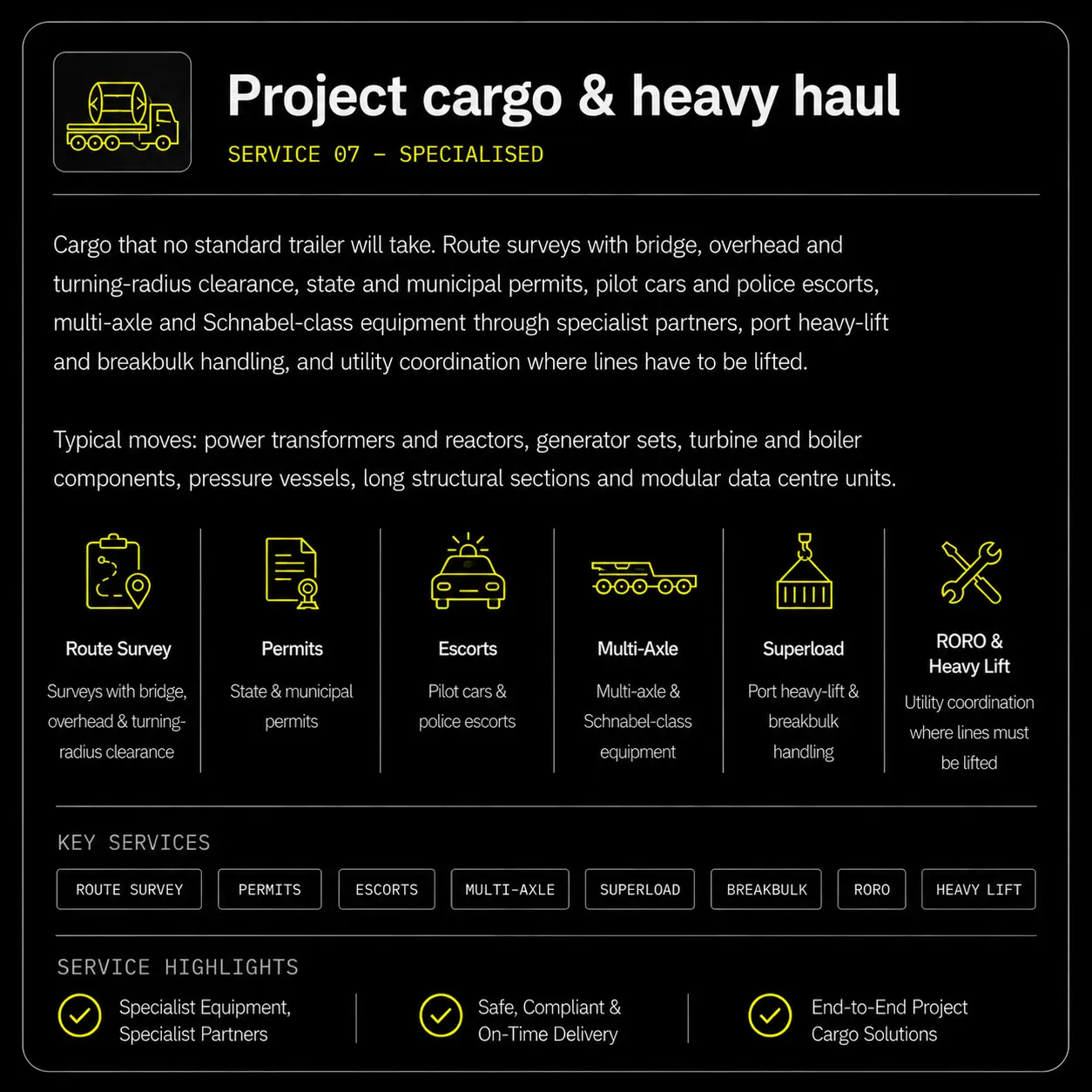
Cargo that no standard trailer will take. Route surveys with bridge, overhead and turning-radius clearance, state and municipal permits, pilot cars and police escorts, multi-axle and Schnabel-class equipment through specialist partners, port heavy-lift and breakbulk handling, and utility coordination where lines have to be lifted.
Typical moves: power transformers and reactors, generator sets, turbine and boiler components, pressure vessels, long structural sections and modular data centre units.
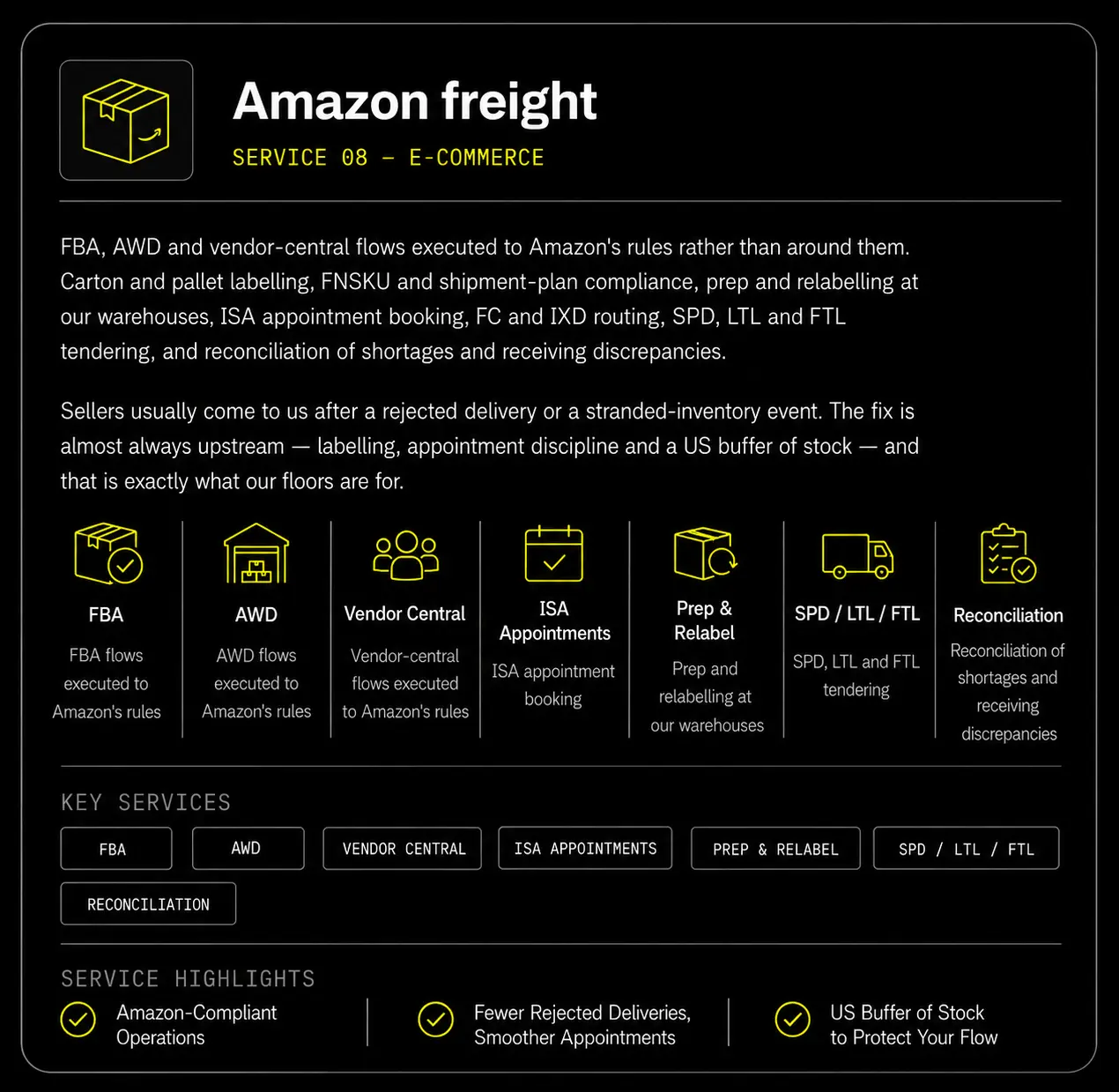
FBA, AWD and vendor-central flows executed to Amazon's rules rather than around them. Carton and pallet labelling, FNSKU and shipment-plan compliance, prep and relabelling at our warehouses, ISA appointment booking, FC and IXD routing, SPD, LTL and FTL tendering, and reconciliation of shortages and receiving discrepancies.
Sellers usually come to us after a rejected delivery or a stranded-inventory event. The fix is almost always upstream — labelling, appointment discipline and a US buffer of stock — and that is exactly what our floors are for.
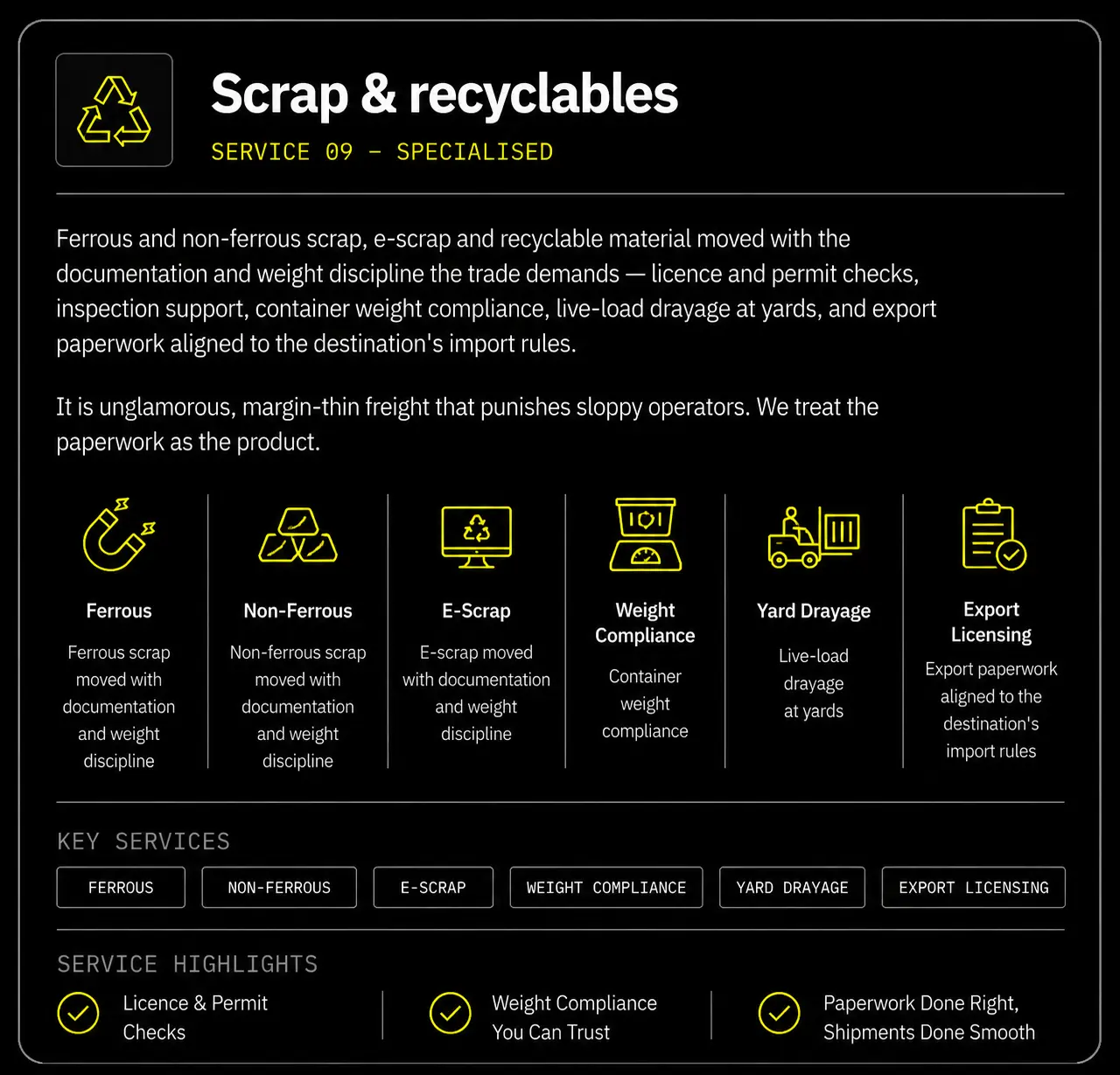
Ferrous and non-ferrous scrap, e-scrap and recyclable material moved with the documentation and weight discipline the trade demands — licence and permit checks, inspection support, container weight compliance, live-load drayage at yards, and export paperwork aligned to the destination's import rules.
It is unglamorous, margin-thin freight that punishes sloppy operators. We treat the paperwork as the product.
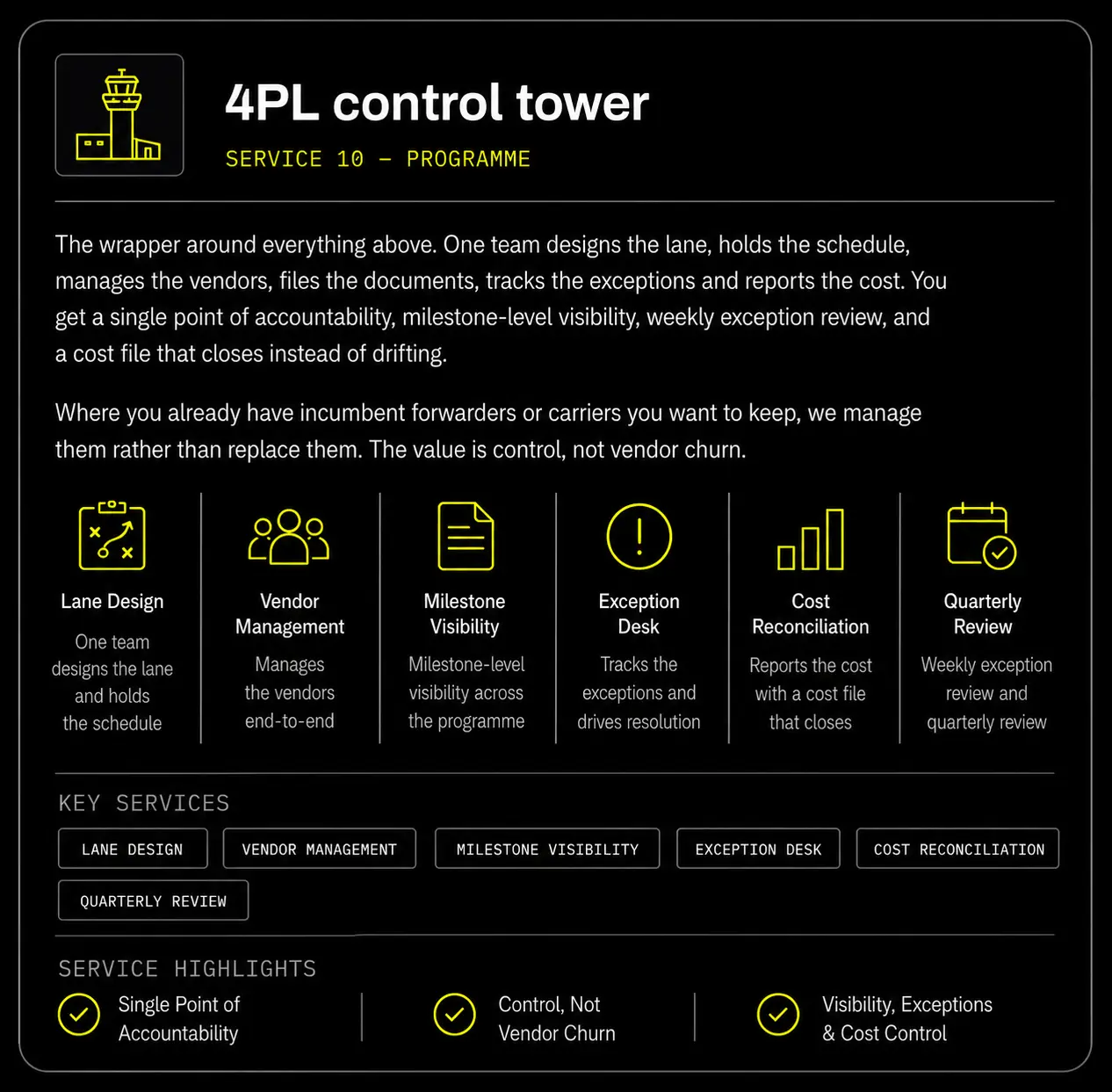
The wrapper around everything above. One team designs the lane, holds the schedule, manages the vendors, files the documents, tracks the exceptions and reports the cost. You get a single point of accountability, milestone-level visibility, weekly exception review, and a cost file that closes instead of drifting.
Where you already have incumbent forwarders or carriers you want to keep, we manage them rather than replace them. The value is control, not vendor churn.

Tell us where the lane breaks — demurrage, permits, duty surprises, rejected appointments — and we'll come back with what we'd change and what it would cost.